


Below is a flow chart demonstrating how a bill becomes a law, taken from the A Guidebook for Ohio Legislators
published by the Legislative Service Commission. For
additional, more indepth information on this topic, please refer to the
Guidebook
.
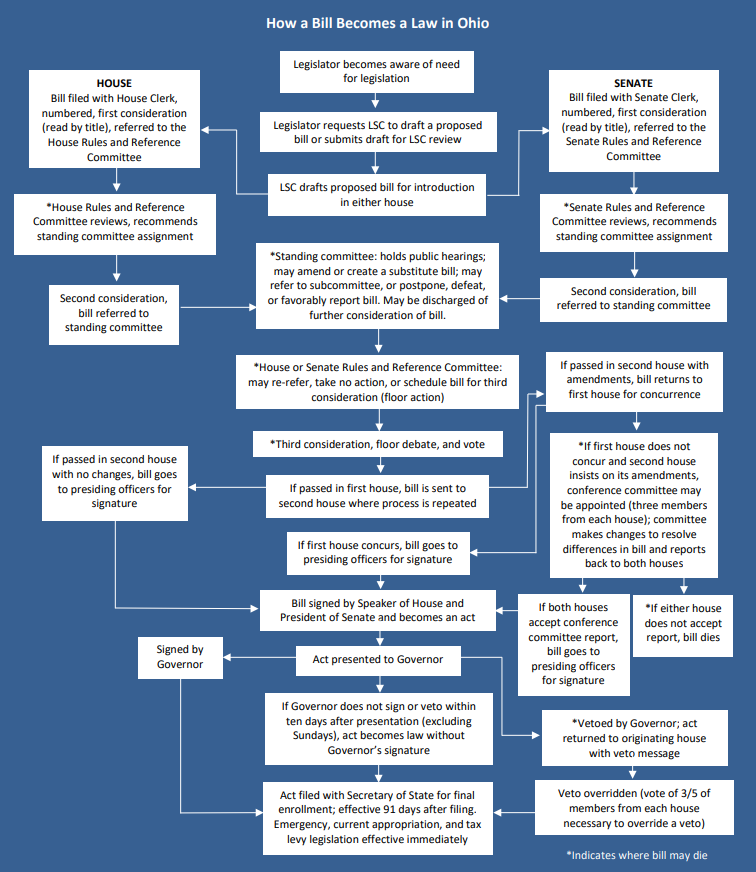
Flowchart titled “How a Bill Becomes a Law in Ohio.” The process starts when a legislator identifies a
need for legislation. The legislator asks the Legislative Service Commission (LSC) to draft a proposed bill or submits a draft for review.
LSC drafts the bill for introduction in either chamber. After introduction, the bill is filed with the chamber clerk, assigned a number,
read for the first time by title, and referred to the Rules and Reference Committee. That committee reviews the bill and recommends assignment
to a standing committee. The bill receives a second consideration and is referred to that committee. In standing committee, public hearings are held.
The committee may amend the bill, create a substitute bill, send it to a subcommittee, postpone action, or defeat the bill. This stage is the first
point where a bill may die if the committee postpones or defeats it, or if it is never discharged or reported out. After committee review, the
Rules and Reference Committee may re‑refer the bill, take no action, or schedule it for a third consideration. If the committee takes no action
and the bill is never scheduled, the bill may die at this stage. At the third consideration, the full chamber debates and votes. If the chamber
does not pass the bill, it dies. If the bill passes, it moves to the other chamber, where the same review process is repeated: committee referral,
public hearings, possible amendments, and a final floor vote. At these stages in the second chamber, the bill may die for the same reasons—committee
defeat or inaction, or failure to pass on the chamber floor. If the second chamber passes the bill without changes, the bill proceeds. If the second
chamber adds amendments, the originating chamber must choose whether to accept them. If the originating chamber does not accept the amendments, a
conference committee may be created. If no committee is formed, the bill dies. The conference committee attempts to resolve differences and issues a report.
Both chambers must vote to accept this conference report. If either chamber rejects the report, the bill dies. If both chambers approve it, or if no
committee was needed, the bill proceeds to the presiding officers for signatures from the Speaker of the House and the President of the Senate.
The bill is then presented to the Governor. The Governor may sign it into law. Alternatively, if the Governor does not sign or veto the bill within ten days
(excluding Sundays), it becomes law without a signature. If the Governor vetoes the bill, it is returned to the originating chamber with a message.
The legislature may attempt to override the veto with a three‑fifths vote in each chamber. If either chamber fails to reach the required three‑fifths
threshold, the override fails and the bill dies. If both chambers successfully override the veto, the bill becomes law. After becoming law, the act
is filed with the Secretary of State for final enrollment. It generally becomes effective 90 days after filing, unless it includes emergency or
referendum language that changes the effective date. The chart includes a note indicating all points where the bill may die: in standing committee,
due to committee inaction, due to failure to pass a floor vote in either chamber, due to lack of agreement on amendments, due to rejection of a
conference committee report, or due to a veto that is not overridden.